Plain-language primerStart here when you want the central claim and reading model before opening formal papers, histories, or the comparative archive.
What Vecnine Is, in Plain Terms
Before the primer walks anything else, one important fact: the calculation returns several positioned types that affect one another. Each type contributes its own pattern and, at the same time, changes how the other types can show. The primer's examples all assume this; nothing in the method reads a number in isolation.
What this page is for
Learn the proposal without collapsing calculation into proof.
Vecnine calculates a reproducible personality sequence and separately records any unplaced types, then tests whether the resulting pattern describes people better than reasonable alternatives.
Boundary: Instincts, wings, arrows, subtypes, and other inherited models are separate lenses. Vecnine does not derive them from the birthdate sequence or require them to calculate it.
The short version
Position supplies role rather than measured dosage, frequency, health, or capacity.
Vecnine calculates a reproducible, ordered sequence from a birthdate. The central psychological hypothesis is that this order meaningfully describes how the nine recurring archetypal patterns combine in one person.
The Enneagram supplies inherited observations about nine character patterns. Vecnine tests a different assignment method: calculate first, then ask whether the resulting sequence predicts motives, tensions, and recurring expressions without relying on a questionnaire or self-selected type.
Day and root supply the Base. Weighted date-derived sources order the Line at positions 3–5 and the later positions after it. Base and Line form the readable Baseline; any absent numbers remain in a separate absence field.
The calculation is established as a repeatable procedure. The birthdate–personality correspondence is not independently validated. Cases, source comparisons, and personal recognition can generate hypotheses; prospective, blind, comparative testing has to decide how much of the psychological claim survives.
That's Vecnine in a paragraph. The rest of this primer walks through it slowly.
Part 1 · What the Enneagram is
If you've never encountered the Enneagram, here's the short version.
A framing note before the descriptions: Vecnine treats all nine as human capacities. The calculation supplies an active order and separately reports the absence field. Order provides reading context rather than psychological magnitude, and absence never means incapacity.
It's a typology of nine character-positions, numbered 1 through 9. Each position has a characteristic preoccupation: an attention pattern, a way of being in the world, a set of strengths, a set of blind spots, a way things tend to go wrong, and a way they come back together. Practitioners describe the nine like this:
- Type 1 · Perfectionist. Standards, fit, discrepancy, and the pressure to correct what does not align.
- Type 2 · Indispensable. Relational significance: attuning, investing, and becoming difficult to do without.
- Type 3 · Performer. Legible value: reading what counts, adapting, and turning capacity into recognized performance.
- Type 4 · Romantic (received alternate: Individualist). Meaningful difference, particularity, longing, and what must not be flattened into equivalence.
- Type 5 · Observer. Investment and reserve: selecting what receives attention, containing resources, and deciding when enough has been gathered.
- Type 6 · Skeptic Sentinel (received alternate: Guardian). Danger, uncertainty, reliability, and verification: testing the ground until it is trustworthy enough to act.
- Type 7 · Enthusiast (received alternate: Adventurer). Appetite, possibility, alternatives, movement, and available nourishment; physical adventure is only one portrait.
- Type 8 · Challenger. Agency, autonomy, resistance, boundary, leverage, and the capacity to act without subjugation.
- Type 9 · Peacemaker. Continuity, cohesion, receptivity, accommodation, and the preservation of an intact field.
The Enneagram differs from preference and trait inventories because its schools organize patterns around motives, defenses, and practices. Claims that it runs deeper than other systems or remains stable across a lifetime require evidence; on this site, those are lineage propositions to explore, not established facts.
Many therapists, coaches, spiritual directors, and organizational consultants use the Enneagram as a generative reflection tool. That practice history is worth documenting without turning use into proof or type language into diagnosis.
That's the half of Vecnine that does the describing.
Part 2 · Why Vecnine tests birthdate as the assignment
This is the part most people find suspicious, and it deserves a direct answer.
The claim is not that the stars determine your personality. The claim is more specific:
Vecnine publishes its method and research questions so arithmetic and interpretation can be evaluated separately:
- The calculation is deterministic. Given a birthdate, anyone applying the same rules gets the same active order and absence field.
- The structural ladder is fixed: positions 1–2 form the Base, positions 3–5 form the Line, the first five form the Baseline, and positions 6–9 remain later positions. The absence field is reported separately.
- Anecdotal recognition and practitioner notes can generate hypotheses, but they do not establish agreement rates or accuracy. No accepted Enneagram gold standard is assumed.
Competing explanations include broad-description effects, expectancy and selection bias, date-linked developmental or demographic variables, an unknown association, and no association at all. A good study must allow each outcome and compare Vecnine with alternative deterministic assignments.
The research program studies how the sequence becomes visible in real people, which descriptions survive counter-portraits, how positions modify one another, and what observations require the model to improve.
You put in your birthdate and receive a complete active sequence plus the absence field. Read the Base first, add the Line to complete the Baseline, then keep the later positions in view. The order contains real structural role, weighting, stacking, and reinforcement without becoming a personality percentage. Observation shows how that structure is expressed in the life.
Part 3 · What the calculation actually does
For readers who want a sense of the mechanics rather than the philosophy, here's how the calculation works at a high level. The full method is in the methodology paper; this is the orientation version.
You take a birthdate (month, day, year). Two short reductions reproduce the Base: reduce the day, then reduce the sum of every digit in the full date. The calculator continues through additional date-derived layers to complete the active sequence. Public readers see the full result; members can inspect the later derivation work. Some numbers can be absent from that active sequence, and the result shows them separately rather than pretending they occupy late positions. An absence describes a lens the calculation did not supply by default, not a missing human capacity.
A reading looks like this:
Read as: 9–5 is the Base; 4–8–1 form the Line; 7 is a lower active position. The numbers 2, 3, and 6 are absent from the active sequence. The pipe separates what is present and ordered from what is absent. It does not turn the left side into a volume slider.
What that arrangement means psychologically is a question for the Enneagram literature and the reader's own observation. Begin with the 9–5 relation, then ask what changes when 4 is added, and continue outward. Reinforcement can make that 4 feel as present as either Base position; the calculation does not settle lived prominence by position alone. The absent field is read as contrast, never as a claim that the person lacks those human capacities.
Other Enneagram schools also use instincts, arrows, wings, and related structures. Vecnine keeps those as separate inherited or observational lenses; they are not required by the core calculation and are not derived from the birthdate sequence.
This is why calculation is a fast starting point: it generates a fixed hypothesis without questionnaire input. It is not thereby a more accurate endpoint. Record what fits, what misses, and what another method would predict.
Part 4 · The convergence catalog
Vecnine places several traditions beside the modern Enneagram to ask where their structures rhyme and where they do not. The catalog is comparative scholarship and a source of hypotheses, not evidence that the calculation works.
The traditions differ in purpose, vocabulary, set size, transmission, and date. Vecnine currently compares:
- The Chinese I Ching and later correspondence traditions.
- Egyptian theological material used in Vecnine’s Rex comparison.
- Sankhya’s three gunas and other Indian classifications.
- Kabbalistic Anthropos and Adam Kadmon material.
- Hellenistic and later alchemical transformation language.
- Sufi accounts of stations and states, including lineages named by later Enneagram teachers.
- Mesopotamian, Chaldean, and later numerological practices.
- Gurdjieff’s enneagram symbol and the modern personality synthesis that followed.
These are non-equivalent sources, and contact or transmission cannot be dismissed as a group. The useful scholarly question is narrower: which correspondences are textually supported, which are later interpretations, and which fail under comparison?
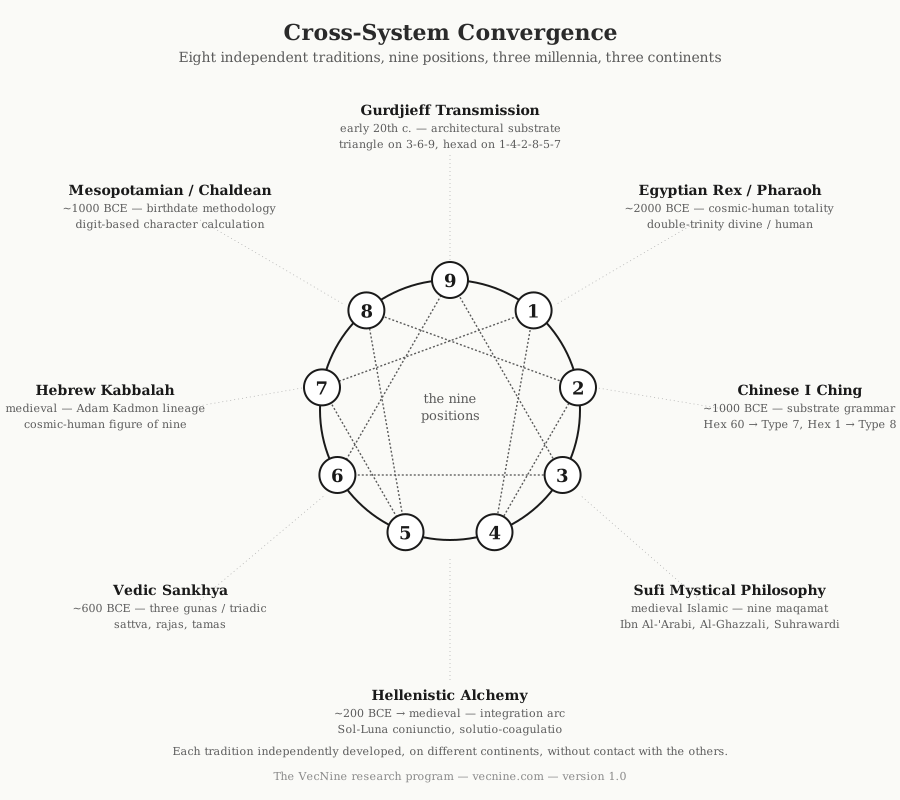
The full catalog links per-tradition research rooms and source notes. Similarity does not establish an ancient Enneagram, a single hidden lineage, or recovery rather than invention; each historical claim must be made at the resolution its sources support.
Part 5 · How we treat the other systems
Vecnine takes a specific posture toward the other character-typological systems. We want to be clear about it.
We don't know exactly what's true and what isn't about astrology, the I Ching as divination, Kabbalah as theology, Sufism as mysticism, Sankhya as cosmology, or alchemy as a transformational practice. Those are deep traditions with their own internal logics, and the people working in them have their own evidence and their own methods. We're not in a position to adjudicate.
What we can say is that these traditions offer several recurring contrasts, cycles, and transformation metaphors worth comparing. We cannot infer that they track one real personality map, nor that similarity validates Vecnine.
The responsible posture is symmetrical: describe each source in its own terms, distinguish primary text from project interpretation, and let disagreement remain visible. Vecnine claims reproducibility for its assignment step, not demonstrated superiority in accuracy.
What Vecnine doesn't claim
- That numerology determines who you are, or that the calculation has already identified an independently established type.
- That other personality systems are useless or shallower. Big Five, Myers–Briggs, and Enneagram frameworks make different kinds of claims.
- That Vecnine is the only valid Enneagram approach or a more accurate one. It adds a different, reproducible assignment to compare.
- That a mechanism or psychological correspondence has been established.
Part 6 · How to start
If you're reading this and thinking "okay, let me try it," here's the path. About thirty minutes total:
- Run the calculator. Free, at vecnine.com. Put in your birthdate. The site produces an active order plus any absences. Thirty seconds.
- Read the Base. The type library has a public description of each of the nine. Read both Base positions and notice what changes in combination. Ten minutes.
- Add the Line. Read the next position, then scan the rest of the active sequence. Treat the order as structural; use reinforcement, context, and repeated observation to judge what feels most prominent. Ten minutes.
- Notice the separate absent field. Absence can point to a lens or filter that is not supplied automatically. It does not mean the person is missing that human capacity. Five minutes.
That is the orientation reading. If it feels recognizable, explore the pattern without treating resonance as proof. If it feels foreign, record the mismatch, check the arithmetic, and compare alternatives. The person is not wrong for contradicting the model.
From there the deeper material (the Atlas tool, the per-instinct subtypes, the integration and disintegration arcs, the cohort findings, the research papers) is available to members. The orientation reading is free, and it's the part most people need.
What's next
The research program is active. The cross-system catalog and per-tradition source notes continue to grow. A future calibration program should preregister its measures, publish mismatches and null results, and separate date arithmetic from claims about people.
We publish research notes, essays, and case studies on the public side of the site. If you want to follow along without committing to anything, the newsletter goes out monthly on the 9th. Sign up at the bottom of any page, or at the newsletter page.
One last thing
A lot of people, when they first encounter a system like this, get a particular kind of suspicion: if this were real, more people would already know about it. That suspicion is reasonable. Here's the answer.
Novelty cannot answer the question “if this were real, wouldn’t we know?” A recent synthesis may be interesting and still be wrong. The only adequate answer is a method clear enough to audit and a claim exposed to independent tests that can fail.
That is why this primer distinguishes sources, calculation, interpretation, and evidence. Accessible writing should not make a stronger claim than the research can carry.
If this primer landed for you, the next step is the calculator. If it didn't, that's fine too. There are many ways to come to self-knowledge, and not all of them go through a system like this. We're trying to build something useful for the people who'll find it useful, and to be honest about what we know and don't know along the way.
Welcome.
— The Vecnine research program
The white paper. The rigorous version of everything sketched above. For practitioners and researchers.
Reproducible map first. What the calculation can settle, and what interpretation still has to earn.
Worked example. A concrete birthdate-to-reading walkthrough.
Research roadmap. What we're working on next.
Questions: research@vecnine.com.
Continue with purpose
Move from orientation to the formal claim
Read the public hypothesis, evidence register, falsification conditions, and protected-method boundary.