Press Kit
At a glance
What Vecnine is: A research program and personality framework. It applies a reproducible birthdate calculation to an Enneagram-informed vocabulary, producing an ordered personality sequence plus a separate record of types not assigned a position.
Why it matters: It cleanly separates repeatable arithmetic from psychological interpretation. The proposed birthdate–personality correspondence is testable and not independently validated; the public materials expose the method, alternatives, and failure conditions.
Where it lives: vecnine.com. The public site includes the calculator, primer, white paper, and per-tradition research papers. A member area holds the deeper layer; Atlas is members-only and included with membership.
Who runs it: James Young, sole maintainer of the the method research program. Based in Port Jervis, New York.
Status: Active research program, approximately five years in development, eighteen months in public-facing operation.
The one-paragraph version
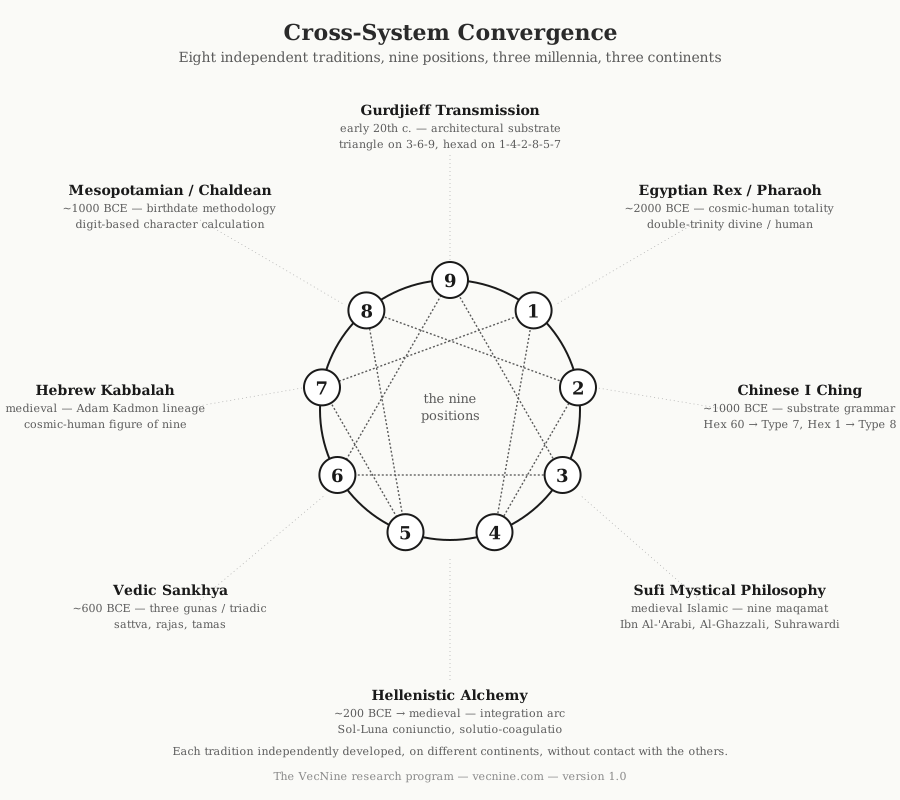
the method publishes a deterministic birthdate calculation and tests an open hypothesis: that its active order and absence field correspond to independently observable personality patterns. It also maintains a comparative catalog spanning the I Ching, Sankhya, alchemy, Kabbalistic Anthropos material, Sufi philosophy, numerological traditions, Egyptian Rex material, and the Gurdjieff transmission. These sources are non-equivalent, their independence is not assumed, and resemblance does not validate the calculation. The method, source notes, research questions, and limits are published at the method.com.
Key facts
Origins
- Developed by James Young over approximately five years of research.
- Built on the modern Enneagram tradition (Gurdjieff → Ichazo → Naranjo, 1920s–1970s) and on the documented numerological lineage extending back to Mesopotamian-Chaldean sources (~1000 BCE).
- The the method synthesis joins birthdate-derived calculation to Enneagram teaching vocabularies, with cautious cross-tradition comparison as a third research axis.
Method
- Calculation is deterministic: given a birthdate, anyone applying the same rules gets the same active order and separate absence field.
- The result contains a structurally primary Base, a weighted Line, later positions, and a separate absence field. It is a weighted structural order, not a personality percentage.
- No astrologer-style interpretive layer; the calculation is mathematical.
- Documented in the methodology paper at the method.com/research.
Findings
- A comparative catalog examines proposed correspondences across eight research rooms; it does not assume identity or independence among traditions.
- Exploratory cohort patterns have generated hypotheses across several selected groups. They are not population prevalence findings or independent validation.
- One internal inter-scorer exercise reported Cohen's κ ≈ 0.60 for its coded catalog; that measures coding agreement under that rubric, not truth of the correspondences.
- Honest-negatives published alongside confirmations (example: the G5 master-number-path mechanism does not preserve under cipher rescaling, 0% across tested cases; reported in the findings paper).
- The Jung research dossier (June 2026) cataloged 17 proposed comparison points with Jung's Collected Works; it does not establish the method as empirical confirmation of unus mundus.
What This does not claim
- Does not claim numerology determines who you are. The calculation assigns a reading map to test; it neither causes personality nor establishes a type.
- Does not claim metaphysical or astrological cosmology.
- Does not claim other personality systems are useless or shallower. Big Five, Myers–Briggs, and Enneagram frameworks make different kinds of claims.
- Does not claim certified-practitioner-monopoly status. There's no the method certification track.
- Does not claim that a psychological correspondence or mechanism has been established. Both remain active research questions.
Common questions journalists / podcasters ask
No. Astrology operates by interpretive mapping of celestial positions at birth onto subjective frames, with substantial variability between astrologers. the method operates by deterministic arithmetic on birthdates with no interpretive step in the calculation. Two practitioners run the same birthdate and get the same result.
No. The papers are public and citable but have not undergone journal peer review, and the psychological claim has not been independently validated. Cross-disciplinary scope does not remove that limitation. Vecnine publishes methods and negative results so independent researchers can audit and test them.
the method borrows and credits Enneagram teaching vocabularies, then adds (1) a reproducible birthdate-derived assignment to test and (2) a comparative catalog of older and modern traditions. It does not claim that calculation has already identified a scientifically established type or that the modern Enneagram was simply recovered intact from isolated ancient cultures.
Three main audiences: practitioners who want a reproducible hypothesis to compare with other evidence; researchers interested in testing birthdate-assignment and cross-tradition claims; and general readers who want an auditable, non-diagnostic reflection framework.
The calculator, public Codex pages, essays, white paper, and research papers are free. One paid membership level is planned for the deeper layer, with Atlas included. Any figures shown on the Join page are draft preview figures; billing is disabled and the site is not accepting payments. The affiliate program is paused at the expression-of-interest stage. There are no live referral codes, commissions, or rewards.
James Young is available for interviews on the research and the underlying typological work. Direct outreach via research@the method.com. Typical interview formats include podcast appearances (60-90 minutes), written Q&A pieces, and occasional in-person conversations.
Useful pull-quotes, researcher's voice
Drawn from the published material. Attributable to "James Young, the method research program" or to "the Vecnine research program."
Useful pull-quotes, general framing
Drawn from the primer paper. Attributable to "the the method research program."
Logistics for media coverage
- Press inquiries: research@the method.com
- Research / methodology questions: research@the method.com
- General correspondence: research@the method.com
- Response time: typically 1-3 business days
- Available for: podcast interviews, written Q&A, conference appearances, contributed essays on related topics
- Not available for: live-broadcast television (logistic constraint, not policy), exclusive embargoed access (we don't operate that way)
Visual / brand assets
- Convergence diagram (the cross-system convergence visual): the method.com/convergence-diagram.svg, SVG, scales to any size, suitable for print or web.
- Official the method identity: download the complete brand kit, or download the primary wordmark, compact 9. mark, and social card separately.
- Founder headshot and interview-specific materials: request from research@the method.com.


Citation format
If citing the method work in published pieces, please use:
- For research papers: "Young, James (2026). [Paper title]. the method research program. Version 1.0. [URL]."
- For the primer or essays: "Young, James (2026). [Essay title]. the method. [URL]."
- For the program / framework generally: "The the method research program (vecnine.com), maintained by James Young."
James Young is the sole maintainer of the the method research program and is the contact for all press inquiries. Email research@the method.com. Typical response time is 1-3 business days.
For podcast bookings, written Q&A pieces, conference appearances, or contributed essays on related topics, please send a brief note describing the format, audience, and timing. We respond to all serious inquiries.
A current fact sheet, not promotional proof
Use the press kit to distinguish reproducible implementation facts, Vecnine’s psychological hypothesis, current evidence, known limits, and features that are not live.
Boundary: Quoted framing should not turn comparison findings into proof, proposed prices into live offers, or calculated case files into certainty about private motives.
Read the public primer
Use the plain-language explanation before covering the deeper papers.